The history of Marsden
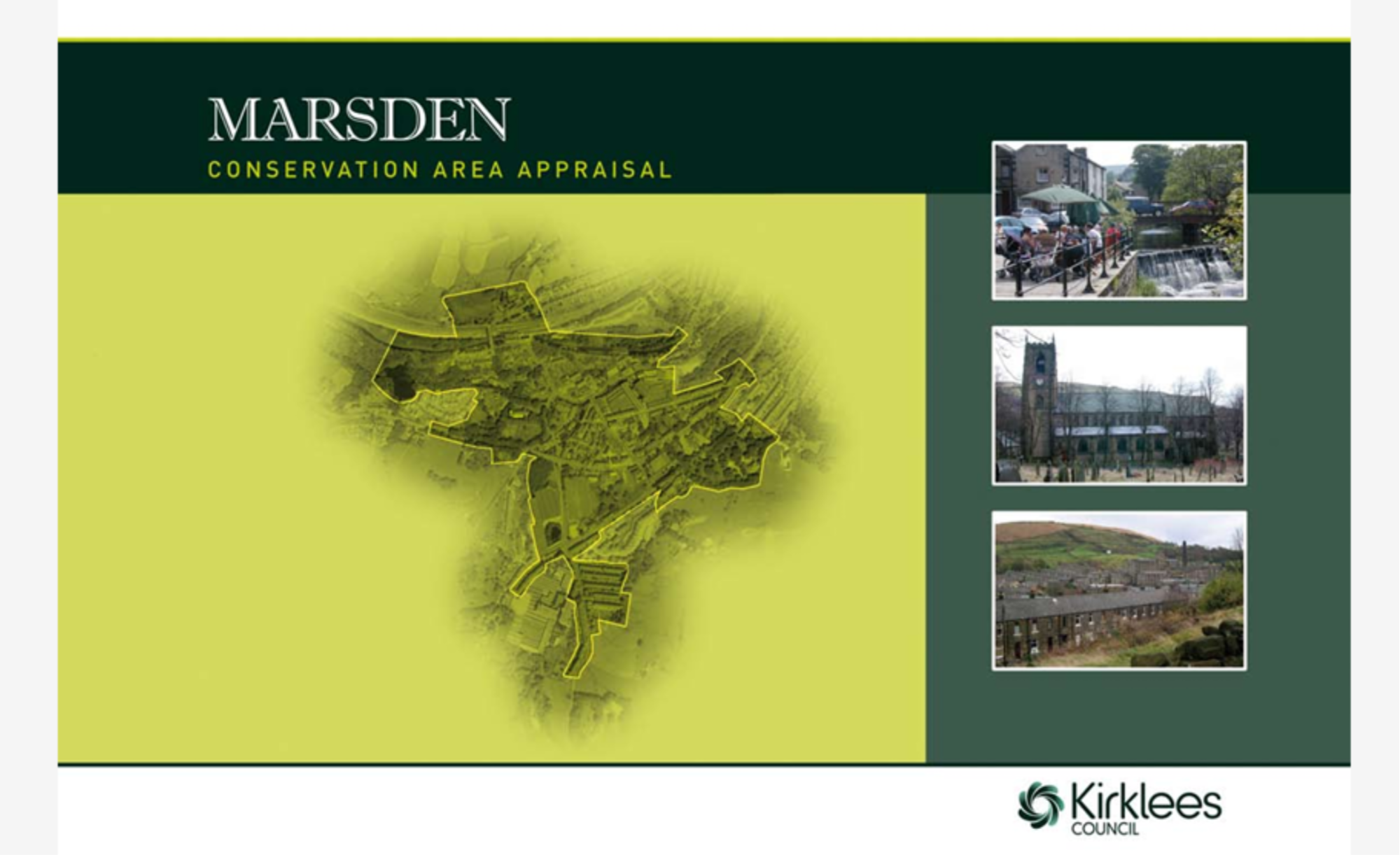
Below you’ll find a summary of Marsden’s history with text taken from the Marsden Conservation Area Appraisal, published by Kirklees Council in 2007. Just click on each arrow to expand further sections and you can find a link to the whole document via the fourth image near the bottom of this page.
-
- The area we now call the centre of Marsden began life surrounded by woodland and the remains of great forests have been found in the moorland peat.
- It was a seasonal hunting ground for Mesolithic tribes whose flint tools have been excavated at March Hill, Warcock Hill and Pule Hill.
- The Romans recognised the value of the Standedge crossing of the Pennines, where the Millstone grit of the Central Pennines is at its narrowest and lowest. Remains of the roman road at Blackstones Edge are believed to be part of a route linking the fortresses of York and Chester.
- The Domesday Book describes the area of Marsden as ‘Waste’ and by 1177 Marsden is identified by the name ‘Marches Dene’ or ‘Marchdene’, which is popularly translated as ‘boundary valley’. Local place names suggest Norse graziers (who arrived from Cumbria) settled the valley.
- The Subsidy Roll of Richard III lists no properties in an impoverished Marsden and in the 4th Century the valley served as a hunting ground for Ilbert de Lacy, the Lord of the Manor of Pontefract.
-
- The early settlement pattern is that of scattered groups of homesteads and outlying farms, with sheep grazed on the hillsides and heath clad moors. The earliest farmsteads have been identified as paying rents in 1424 at Binn, Clough Lee and Lingards.
- In 1557 the population had increased to 400. Marsden at this time was a remote and wet hamlet prone to flooding. Farming continued to be marginal and to subsidise their income the inhabitants relied on the dual economy of the textile industry and cloth making. Initially, this was produced at a domestic scale from cottages and hamlets clustered on hillside terraces, such as Green Top (1671) and Berry Greave Farm (1685).
- During medieval times traders and travellers passed through Marsden, the unusual number of innkeepers being testament to this.
- At the time of the Hearth Tax (1666) approximately 550 people and 82 houses were recorded in Marsden; by 1891 the population had increased to 3,855.
-
- The Industrial Revolution meant that developments in spinning technology and mass production gradually changed the domestic manufacture of textiles. The early textile mills were constructed and powered by nearby streams in the steep tributary valleys, but the processes of spinning and weaving was still undertaken at home as part of the domestic system.
- The first fulling mill appeared in Hey Green in 1710. Its purpose was to thicken the woven cloth for the production of Kersey, a coarse, low quality cloth; only the mill dam and stables now remain.
- In 1798 Black Fever killed 300 people and the level of the then graveyard had to be increased to accommodate them.
-
- Transportation and communication has always been fundamental to the development of Marsden. The early packhorse routes converged at the original heart of the town at Towngate. This area was made up of a dense cluster of narrow back streets and inns.
- With the increases in trade, the packhorse routes over the Pennines were insufficient and new turnpikes were constructed (3 between 1759 and1839). Coaches would rest on the journey between Huddersfield and Manchester at the Old New Inn.
- However, this was still inadequate for transporting bulk freight carriage and a company was therefore set up to construct the Huddersfield Narrow Canal. This company completed construction of the canal in 1811 and this included a section through Standedge Tunnel, the longest and highest canal tunnel in the world.
- As a result of improved communication Marsden grew rapidly. At the beginning of the 19th century most of the local population was involved in the processes relating to woollen cloth, cotton and silk textiles, although the construction of mills, canals, railways and reservoirs also brought large numbers of navvies to the area.
-
- The construction of the mills had a profound impact on the largely rural landscape of Marsden.
- Ironworks and engineering industries also expanded during this period and Enoch and James Taylor established a foundry in Marsden in the early 1800s to manufacture shearing frames.
- This machinery was significant in the history of the Luddites, a band of ‘croppers’ objecting to being replaced by machines and mechanisation, with local incidents of industrial action culminating in the murder of a local mill owner in 1812. The business continued to develop and manufactured steam engines and boiler making.
-
- In 1845 the railway was constructed through Marsden and subsequently manufacturing expanded rapidly, local families such as the Crowthers built many mills, and a number of community buildings were constructed, such as Marsden Mechanics Institute, the Park, St Bartholomew’s Church and additional town improvements.
- A number of mill owners’ homes, such as at Inner Hey, and terrace housing for the workforce, were built during this time out of the profits made from textiles.
- By the end of the 19th century larger mills, such as Bank Bottom, New Mills, Clough Lea and Holme Mills, were replacing the smaller mills. The mills continued to expand rapidly, stimulated by orders of army uniforms at the outbreak of the First World War.
- The population of Marsden grew to 5,757 by 1911.
- In the 20th century the village had its own ambulance and fire service on the Manchester Road.
-
- The textile industry began to decline in the 1960s although some mills continued until the 1990s.
- Areas which were unsanitary and unfit for human habitation, such as the Planks area in the centre of Marsden were demolished and since then derelict industrial sites and demolished mills have provided land on which to build private estates, mainly for commuters to the nearby city of Leeds and Manchester.
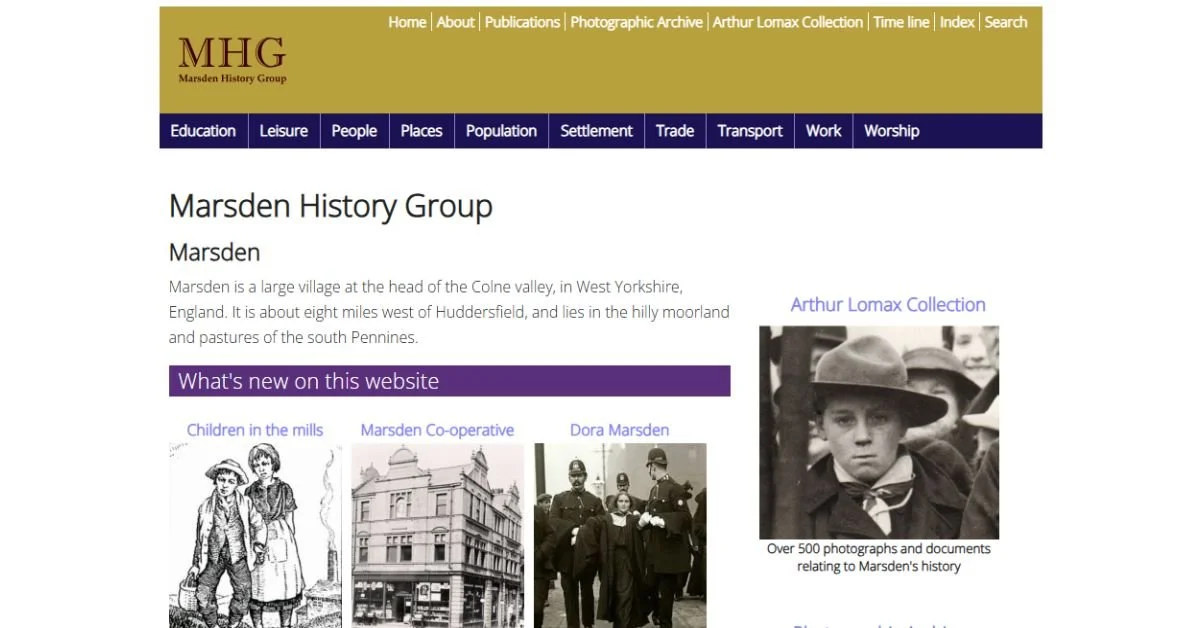
MARSDEN HISTORY GROUP WEBSITE
To find out more about Marsden’s history (including an extensive archive of photographs) you can explore the Marsden History Group website, linked through the image below. You’ll also find their main profile within the ‘Groups and Activities’ section of this site, under ‘Cultural groups’.
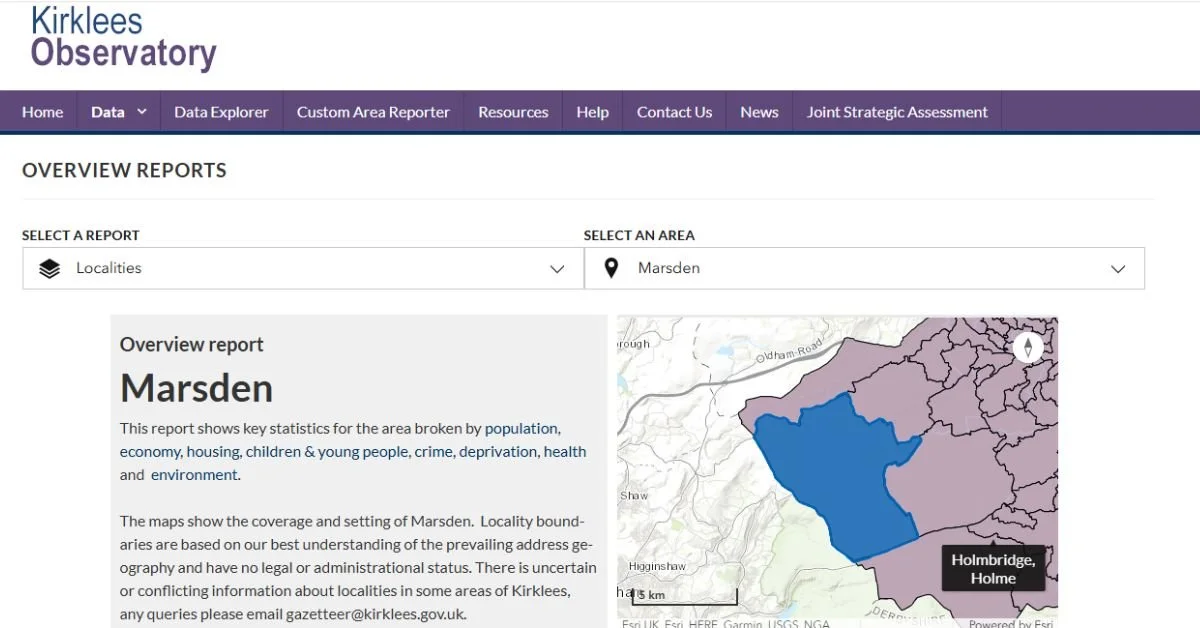
THE KIRKLEES OBSERVATORY
To learn more about the population of Marsden as it is now, just follow the link to the Kirklees Observatory in the image below.
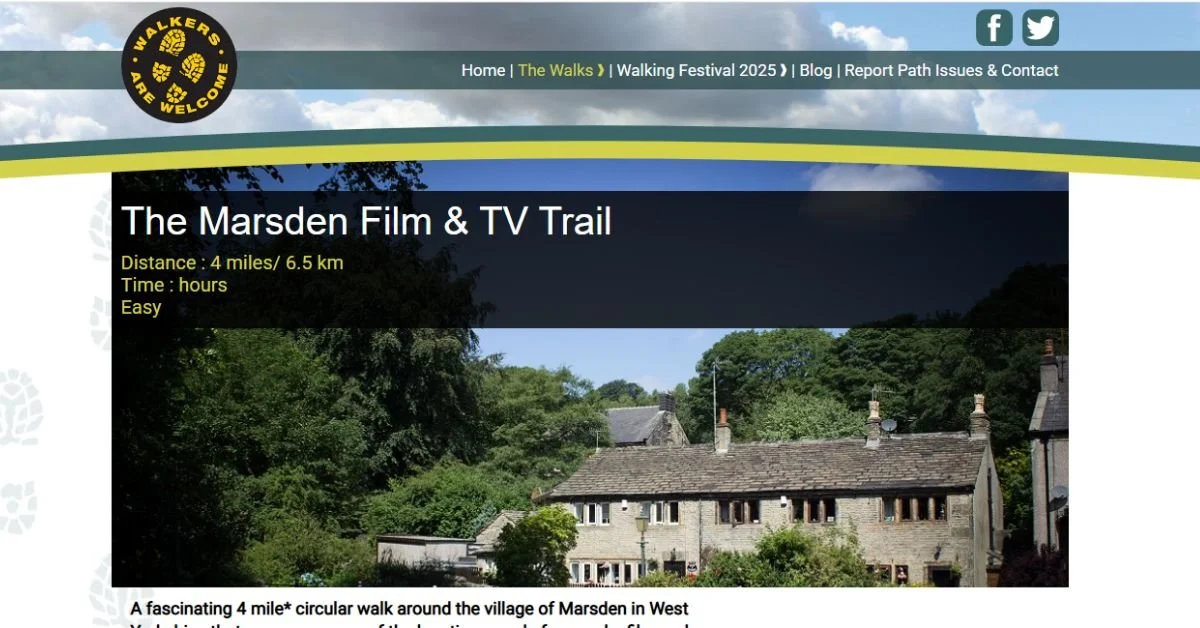
MARSDEN IN FILM AND ON TV
Marsden has been used as the backdrop for everything from TV dramas to a Hollywood blockbuster. If you want to see where the scenes were set, consider following the Marsden Film and TV Trail walk put together by Marsden Walkers are Welcome - click on the image below to find out more.
MARSDEN CONSERVATION AREA APPRAISAL DOCUMENT
The early sections of this document are useful to explore the village’s history further - to download it, follow the link to the Kirklees site via the image below, scroll down the list of conservation area maps and appraisals, find Marsden and click on ‘Marsden appraisal’.